





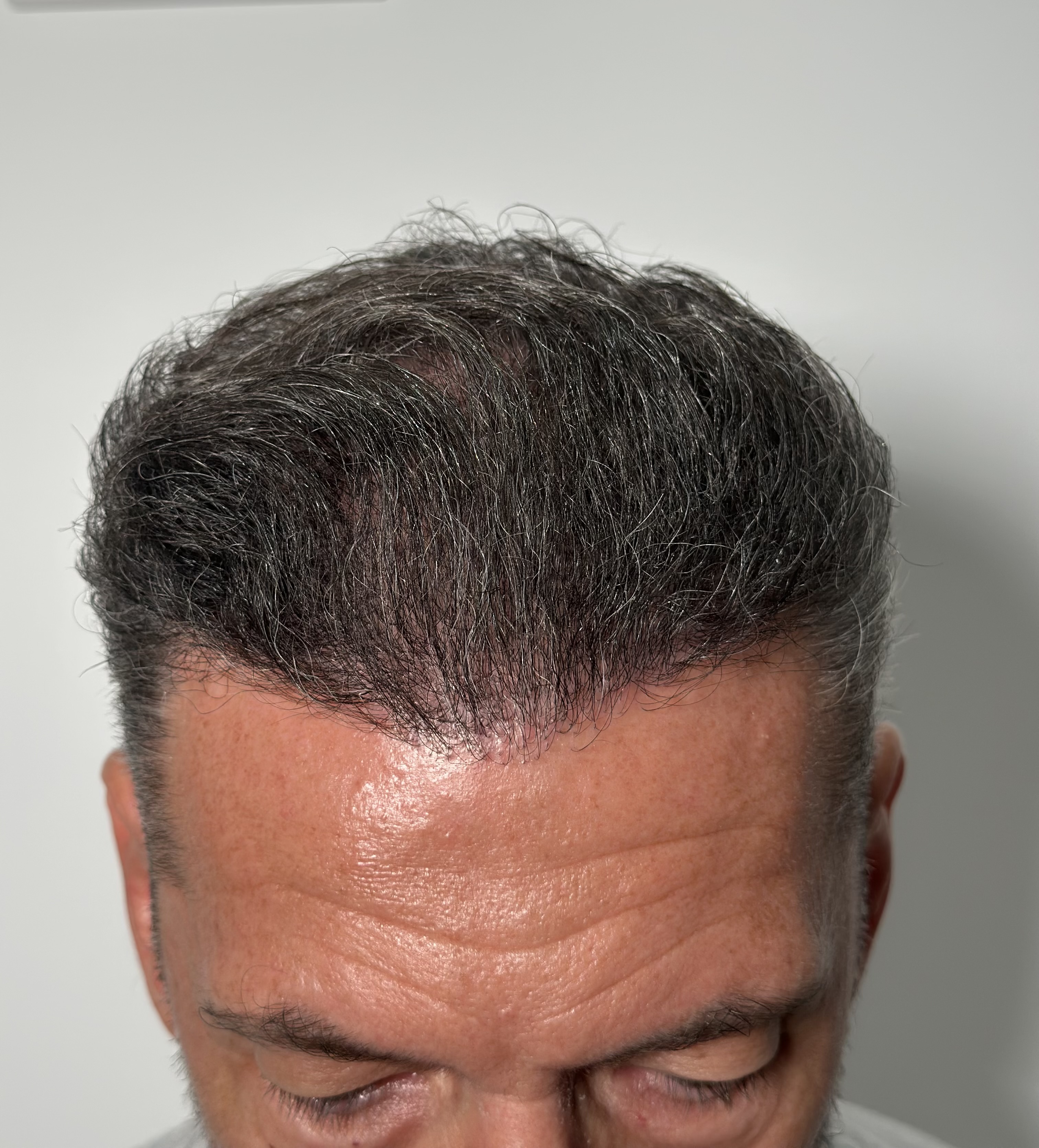


This is one of the most common fears before taking the plunge: what if the results don't live up to expectations? Images of artificial hairlines or ravaged donor areas, often associated with low-cost, assembly-line procedures, fuel this anxiety. The good news is that a disappointing transplant can often be corrected. However, you first need to understand what went wrong. Here is a clear guide, created by Hexagone Clinic in Nice.
1. How to recognize a failed hair transplant?
Not all imperfect results are definitive failures; some are just a stage before final maturation (we will come back to this below). However, several signs should be genuine cause for concern:
- Insufficient or uneven density : the recipient area has "gaps," asymmetries, or stark contrasts between dense and sparse patches.
- No regrowth after 12 months : beyond this period, a near-zero result raises questions about graft survival.
- An unnatural hairline : too low, too straight, too dense all at once, or designed without considering the shape of the face.
- A "pluggy" appearance : implants that are too widely spaced or poorly angled create an unnatural, doll-like effect.
- A damaged donor area : over-harvesting that leaves the back of the scalp visibly sparse, or a highly visible scar.
To get an idea of what a professional result actually looks like, our patient results serve as a benchmark.
2. The most frequent causes
A disappointing transplant is rarely a matter of chance. The recurring factors are:
- A poor initial diagnosis : offering a transplant to a patient whose hair loss has not stabilized, or whose donor area is too weak, almost always leads to disappointment. This is why seriously evaluating the donor area is crucial.
- Industrial-scale volume : when a clinic processes a large number of patients per day, the time dedicated to each step decreases, to the detriment of graft survival.
- Neglected artistic design : the hairline and the angle of the hair make all the difference between a natural result and one that looks "pluggy."
- Imprecise technique : traumatic extraction, poor graft preservation, or poorly angled implantation compromise regrowth. The technique used and the surgeon's expertise are therefore decisive.
These situations are more common in clinics that prioritize volume and low prices. We detail this in our comparison hair transplants in Turkey: the real pitfalls.
3. Should you wait before judging the results?
Yes, and it is essential. Many patients worry too soon. In the weeks following the procedure, the transplanted hair falls out: this is the "shock loss" phase, which is perfectly normal. Regrowth then occurs gradually, and the final result can only be truly assessed between 12 and 18 months. Calling it a failure before this period is premature in most cases.
4. What are the solutions for correcting a failed transplant?
Depending on the nature of the problem, several approaches exist:
- Corrective transplant : a second, carefully planned procedure can restore density, fill in sparse areas, or rework a poorly designed hairline. However, this requires a donor area that is still viable, which is why preserving it is so important.
- Scalp micropigmentation (SMP) : injecting pigments mimics the appearance of hair follicles and can camouflage a scar or visually densify a thinning area.
- Laser treatment for a hairline that is too low : when a hairline has been implanted too low, laser hair removal can be used to gradually raise it over several sessions.
None of these solutions are automatic: the choice depends on the condition of the scalp, the remaining donor area, and individual expectations. This is precisely what an in-depth consultation helps to clarify.
5. How can you avoid a failed transplant from the start?
The best correction is the one you never need. A few simple habits can protect your project: verify the experience and actual results of the facility, be wary of abnormally low prices (see our transparent pricing as a point of comparison), ensure there is genuine medical follow-up before and after, and take the time to choose your clinic without rushing into a decision.
Frequently Asked Questions
Can a botched hair transplant always be corrected?
Often, yes, but not always to the same extent. It all depends on the remaining donor area and the nature of the issue. An initial consultation allows us to evaluate what is possible.
How long should I wait before a correction?
In general, it is recommended to wait for the initial results to fully mature, which takes 12 to 18 months, before considering a revision.
Why do low-cost transplants abroad fail more often?
The model is often based on volume: many patients treated per day, less time spent per procedure, and limited follow-up once you return home.
Unsure about your transplant or your plans?
Whether you are considering your first transplant or looking to correct a disappointing result, the starting point is the same: an honest discussion about your situation. Let's talk, with no obligation. Our team in Nice will get back to you within 24 business hours.
→ Request a callback · ✓ Response within 24 hours · ✓ 100% confidential · ✓ No obligation