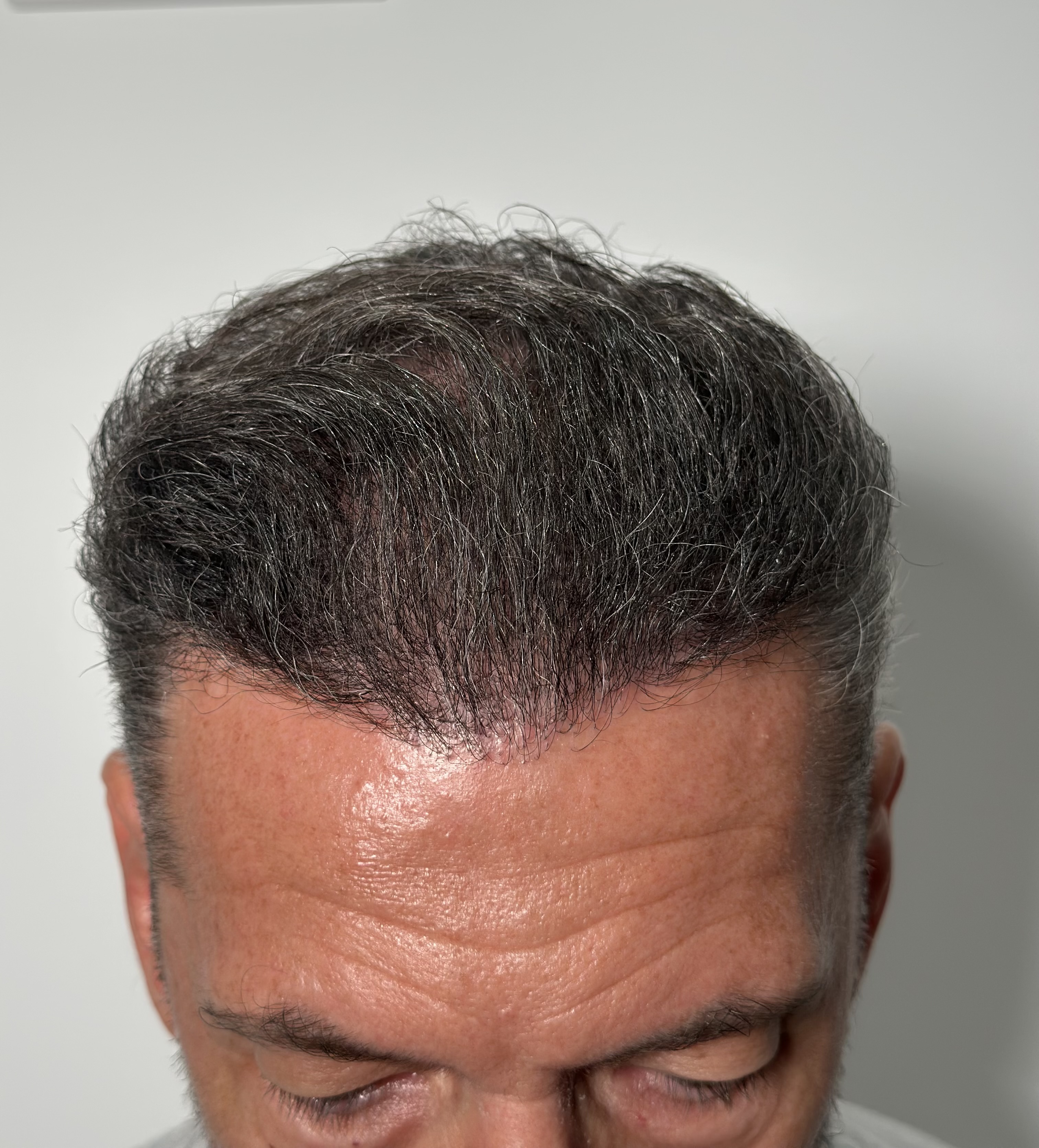





Advanced Norwood stage V, VI, or VII hair loss raises a question that few clinics address honestly: can a large balding area really be covered in a single procedure? Maxi sessions of 4,000 grafts or more exist, but they are not suitable for every patient. This article details the eligibility requirements, the procedure itself, and the criteria that determine whether this approach is right for you.
1. What is a hair transplant maxi session?
A maxi session refers to a procedure in which 4,000 or more grafts are extracted and implanted in a single day, or sometimes over two consecutive days. With an average of 2 to 3 hairs per graft, this represents 8,000 to 12,000 transplanted hairs—enough to treat the hairline, vertex, and mid-scalp simultaneously.
This approach contrasts with the strategy of split sessions, where restoration is spread over two or three procedures spaced 12 to 18 months apart. Each option has specific indications, and the choice should never be based on a sales pitch.
2. Who is a candidate for a session of 4,000 grafts or more?
Three conditions must be met:
a. A sufficiently dense donor area
This is the deciding factor. The donor area—the occipital and temporal crown—contains an average of 4,000 to 7,000 usable grafts over a lifetime. Extracting 4,000 grafts in one session means utilizing a significant portion of this capital. If the native density is insufficient, the extraction will leave a sparse appearance visible at the back of the head.
At Hexagone Clinic, this assessment is based on the Tricholab 3D : a three-dimensional map of the donor area that measures actual follicular density (grafts/cm²), the ratio of hairs per follicular unit, and the caliber of the hair shafts. This quantitative analysis allows us to determine, before any decision is made, how many grafts can be harvested without compromising the appearance of the donor area or future options.
b. A recipient area consistent with the number of grafts
Implanting 4,000 grafts into a small area makes no sense: scalp vascularization limits the viable implantation density per cm². A maxi session is indicated when the area to be covered is extensive (generally 150 to 250 cm²), typically for Norwood stages V to VII.
c. A compatible scalp and general health
A long session requires good scalp elasticity, proper vascularization, and the absence of contraindications (such as coagulation disorders or active scalp dermatological conditions). These factors are verified during the medical consultation prior to any procedure.
3. What if the scalp donor area is not enough?
For very extensive hair loss with limited donor capital, the BHT (Body Hair Transplant) technique allows us to supplement the harvest with grafts from the beard or chest. We have dedicated a full article to this: BHT, the solution when the scalp donor area is insufficient.
4. What happens during a maxi session?
The day before and the morning of: shaving the donor area, marking the implantation sites, and preoperative checks. The procedure is performed under local anesthesia.
Extraction phase (morning): grafts are harvested one by one using the FUE protocol, with 0.8 to 0.9 mm punches. Extraction follows the mapping established by Tricholab 3D to ensure the harvest is distributed evenly and remains invisible.
Storage: grafts are sorted by hair count (units of 1, 2, or 3 hairs) and stored in a temperature-controlled preservation solution. For a maxi session, the time spent outside the body is a critical factor: the protocol is organized to minimize the time between extraction and reimplantation.
Implantation phase (afternoon, or even the following day): single follicular units are reserved for the frontal hairline for a natural look; multiple units are used to densify the mid-scalp and vertex. The angle, direction, and depth of implantation follow the natural growth pattern.
Total duration: expect 8 to 10 hours for 4,000 grafts in a single day, including breaks. For more than 4,500 grafts, splitting the procedure over two consecutive days is often preferred to maintain implantation quality and patient comfort.
5. Maxi session or two separate sessions: how to choose?
A maxi session is appropriate when:
- the donor supply is confirmed to be abundant by Tricholab 3D analysis;
- the hair loss is stabilized (no active progression);
- the patient wants a complete result with only one recovery period;
- logistics are a factor: one procedure, one period of time off work.
Splitting the procedure is preferable when:
- the hair loss is still progressing (to preserve donor supply for the future);
- the donor area is average: it is better to have an initial session of 2,500–3,000 grafts and then re-evaluate;
- the priority is the frontal hairline, and the vertex can wait.
A key point: the number of grafts is not an objective in itself. A well-planned 3,000-graft session in the right areas often produces a greater visual impact than 4,500 scattered grafts. Perceived density depends on placement, hair caliber, and skin/hair contrast, not just the volume extracted.
6. What results can you expect?
The timeline is identical to any FUE transplant: temporary shedding of transplanted hair between the 2nd and 6th week, regrowth starting around the 3rd to 4th month, and final results visible between the 12th and 18th month. In a maxi-session covering multiple areas, full maturation of the crown is generally the slowest.
The graft survival rate depends directly on the quality of the extraction, storage, and implantation protocol—which is why it is important to choose a clinic that is transparent about its methods.
7. What is the price of a maxi-session in Nice?
At Hexagone Clinic, pricing is structured by graft tiers:
- up to approximately €6,800 for a 4,000-graft session;
- the overall range for hair transplants is from €2,800 to €7,800, depending on the number of grafts and the complexity of the case.
The exact price is determined after the hair assessment, once the number of grafts required has been objectively established by Tricholab 3D analysis. Unlike some offers abroad billed at a "flat unlimited rate," our quote is based on a real measurement of your needs and your donor supply—not on a promise of volume. For a detailed comparison, see our article Hair transplant: Nice or Turkey?
Frequently asked questions
Is 4,000 grafts painful?
The procedure is performed under local anesthesia. The length of the session is more a matter of endurance than pain; breaks are scheduled, and the anesthesia is maintained throughout the day.
Can 5,000 or 6,000 grafts be done in one go?
Technically, 5,000+ graft sessions exist, often spread over two days. However, few donor areas can provide such volume without aesthetic damage. Any promise of "6,000 guaranteed grafts" made before an analysis of your donor density should be a red flag.
How much downtime should I expect?
Scabs disappear in 8 to 12 days. Returning to office work is possible within 5 to 7 days; sports can be resumed gradually starting from the 3rd or 4th week.
Will the donor area be visible after such an extraction?
That is precisely the purpose of Tricholab 3D mapping: to distribute 4,000 extractions evenly across the entire donor area so that the decrease in density remains imperceptible to the naked eye, even with short hair.
How do I know if a maxi-session is possible in my case?
The only reliable answer comes from measurement. The hair assessment at Hexagone Clinic includes a Tricholab 3D analysis of your donor area: actual density, usable capital, and a precise estimate of the number of grafts available. You leave with objective data—not just an eyeball estimate.
Book your hair assessment in Nice:
📞 +33 4 65 84 53 65
💬 WhatsApp: +33 6 63 92 80 87
📍 4 Rue du Docteur Barety, 06000 Nice