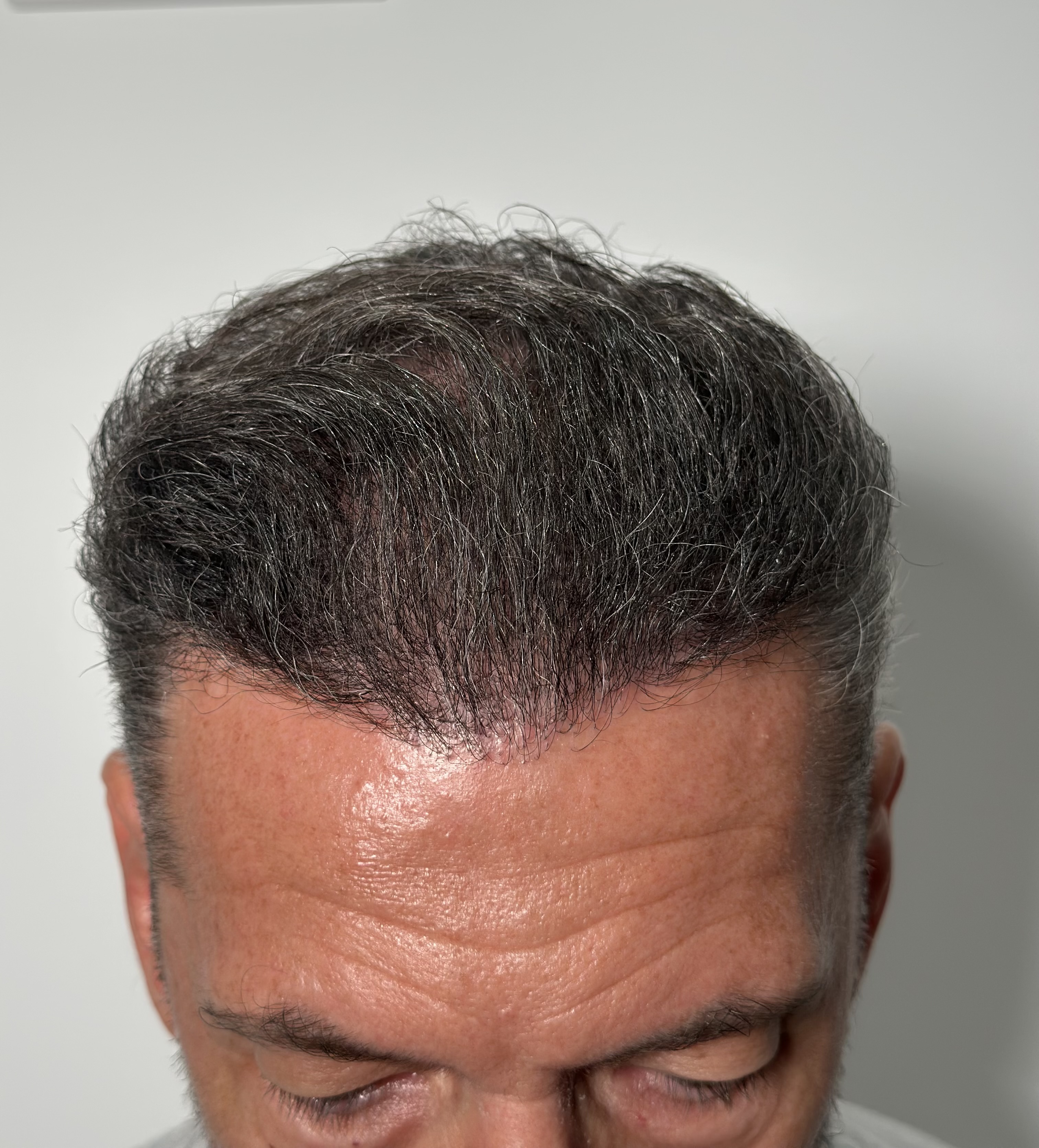





A forehead perceived as too high alters the overall proportions of the face. Whether due to a naturally high hairline, a gradual recession of the temples, or an irregular frontal line, lowering it via hair transplant allows for the creation of a dense, natural-looking border—without any linear scarring. Here is how this procedure works, who it is for, and what distinguishes a successful result from an artificial-looking hairline.
1. High forehead: what exactly are we talking about?
In adults, the hairline is located on average 6–8 cm above the glabella (the space between the eyebrows) for men, and 5–6.5 cm for women. Beyond this, the forehead visually dominates the upper third of the face. Three situations typically lead to a consultation:
- Constitutional high hairline : the hairline has always been set back, without any hair loss. This is a common reason for consultation among women.
- Acquired recession : temples that recede and a hairline that gradually moves back (Norwood stages II–III in men, frontal Ludwig-type recession in women).
- Irregular or asymmetrical hairline : following a poorly designed previous transplant, a scar, or traction alopecia.
2. FUE transplant or surgical forehead reduction: two different approaches
There are two ways to lower a hairline. Surgical forehead reduction involves removing a strip of skin from the forehead and advancing the scalp; it lowers the hairline by 1.5 to 3 cm in one go, but leaves a scar along the new border and is only suitable for certain very lax scalps.
TheFUE transplant lowering method, performed at Hexagone Clinic, relies on implanting grafts harvested from the donor area to build a new border 1 to 2.5 cm lower. Its advantages: no linear scarring, total control over the design (shape, micro-irregularities, temples), and the ability to correct asymmetries. The trade-off: the final result is visible after the full regrowth cycle, which is about 12 months.
3. What makes for a successful lowering: design above all
A natural hairline is never just a line. It is a transition zone 5 to 10 mm thick, built according to precise rules:
- Single-hair follicular units exclusively in the first row, implanted in a deliberately irregular pattern (micro-zigzags), because a straight hairline immediately reveals a transplant;
- A density gradient : sparse for the first 2-3 millimeters, then gradually increasing in density toward the back with 2- and 3-hair units;
- Very acute implantation angles (15-25° relative to the scalp), oriented forward to replicate natural growth;
- Respect for facial proportions : the new hairline is positioned according to the rule of thirds and the mobility of the frontalis muscle - lowering it too much freezes the expression and paradoxically makes the face look older.
For women, this also includes the reconstruction of fine border hairs and the rounding of the fronto-temporal angles, which are characteristic of a feminine hairline.
4. How many grafts are needed to lower a hairline?
It all depends on the surface area to be covered and the desired density:
- Moderate lowering (1 cm) or temple point correction : 800 to 1,200 grafts;
- Lowering by 1.5 to 2 cm across the entire width of the forehead : 1,200 to 1,800 grafts;
- Lowering by 2 to 2.5 cm with temple point reconstruction : 1,800 to 2,500 grafts.
The exact cost is determined during your hair assessment, based on the analysis from Tricholab 3D : this mapping measures your actual donor density and ensures that the required extraction does not deplete the reserves you might need in the future—a critical factor for younger patients whose hair loss may continue to progress.
5. The specific case of younger patients
This is the most delicate aspect of the procedure. Lowering the hairline of a 25-year-old man with active hair loss risks leaving an isolated frontal island ten years later if the recession continues behind the grafted area. Our protocol therefore systematically incorporates an assessment of hair loss stability and the preservation of donor reserves. In some cases, the honest recommendation is to wait or to stabilize the hair loss first—even if that is not the answer you were hoping for.
6. Procedure overview
Pre-operative design: the new hairline is drawn in front of a mirror and validated with you from several angles, both with your face at rest and in motion. Nothing is implanted without your approval of the design.
Extraction: grafts are harvested from the occipital area using the FUE protocol (0.8 mm punches), prioritizing fine, single-hair follicular units for the hairline.
Implantation: performed under local anesthesia, respecting the angles, directions, and density gradient defined during the design phase. Allow 4 to 6 hours for 1,200 to 1,800 grafts.
Recovery: scabs persist for 8 to 10 days, with mild forehead redness possible for a few days longer. You can return to office work within 5 to 7 days. As the area is highly visible, many patients schedule the procedure before a period of remote work or vacation.
7. What results can I expect, and when?
The implanted hairs will shed temporarily between the 2nd and 6th week—this is normal and expected. Regrowth begins around the 3rd to 4th month, the hairline becomes clearly defined by the 6th to 8th month, and the final result (density, texture, and blending with native hair) is visible at 12 months. The transplanted hair is permanent, as it comes from an area genetically resistant to androgenetic hair loss.
8. What is the cost of a hairline lowering procedure in Nice?
At Hexagone Clinic, pricing follows the graft tiers applicable to all hair transplants, ranging from €2,800 to €7,800 depending on the volume. A hairline lowering procedure typically falls in the lower to middle range of this bracket (800 to 2,500 grafts). A precise quote is provided after your hair assessment, once the number of grafts has been objectively determined by the Tricholab 3D analysis—never before.
Frequently Asked Questions
Does it look natural up close?
Yes, provided the hairline is constructed using single-hair units with micro-irregularities and closed angles. It is the design and selection of the grafts that create a natural look, not the quantity.
Is hairline lowering suitable for women?
It is actually one of the primary indications. A naturally high female hairline responds very well to transplantation, with specific design features (rounded angles, baby hairs) integrated into the protocol.
Can it be lowered by 3 cm or more?
With a transplant alone, lowering beyond 2.5 cm requires a significant volume of grafts and heavily draws on your donor supply. The Tricholab 3D analysis determines what is reasonable in your case; a two-stage procedure is sometimes preferable.
What if I have already had a failed frontal transplant elsewhere?
Correcting artificial-looking hairlines (straight borders, multi-hair grafts in the front row, poor orientation) is a common procedure. The hair assessment evaluates what can be removed, redistributed, or densified.
Check your eligibility: the hair assessment
The feasibility of a frontal lowering depends on three measurements: your donor supply, the stability of your hair loss, and your facial proportions. The hair assessment at Hexagone Clinic, which includes a Tricholab 3D analysis, provides you with these three quantified answers before any commitment.
Book your hair assessment in Nice:
📞 +33 4 65 84 53 65
💬 WhatsApp: +33 6 63 92 80 87
📍 4 Rue du Docteur Barety, 06000 Nice