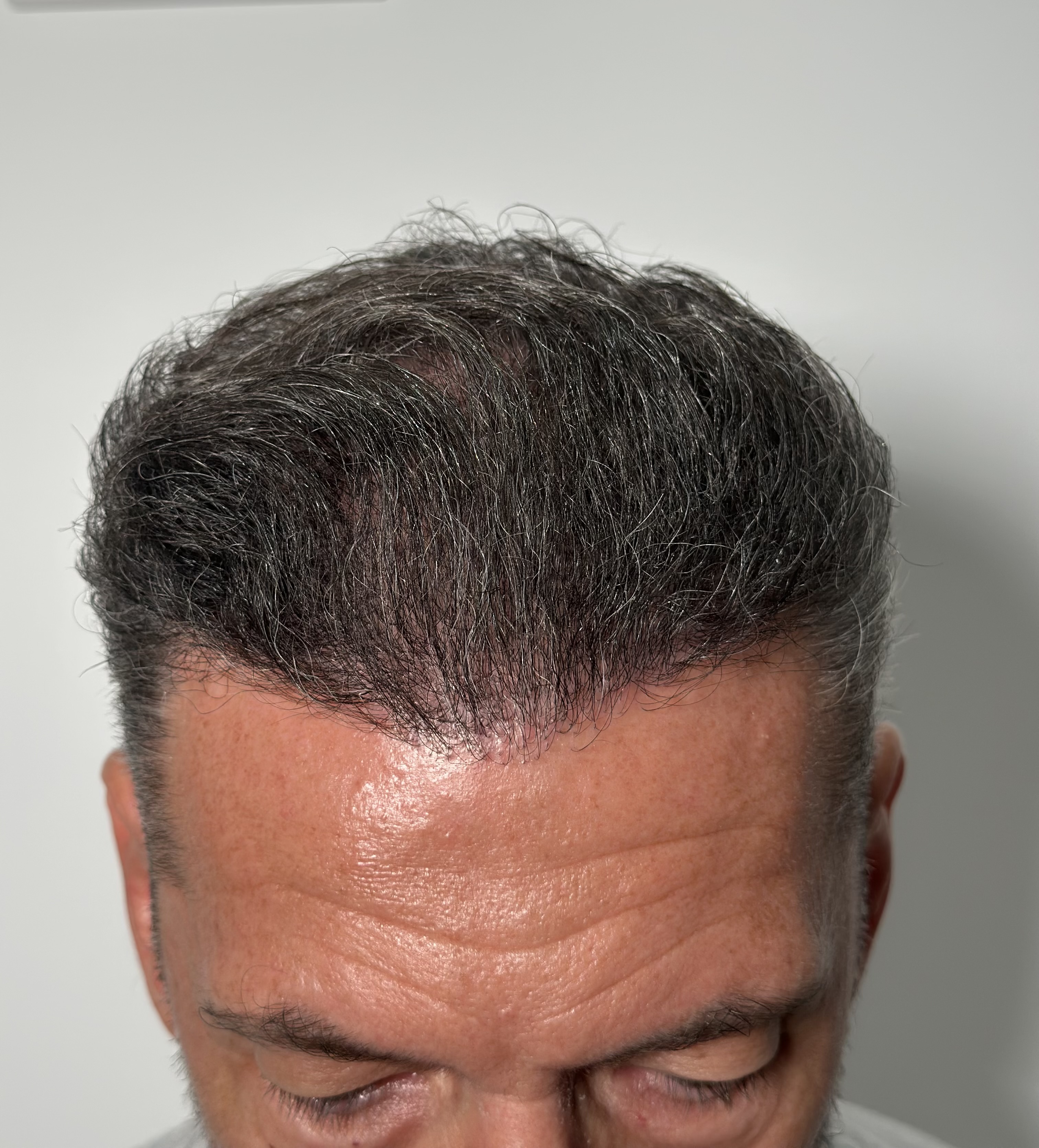





Sapphire FUE on one side, DHI on the other: these are currently the two terms most heavily promoted by hair transplant clinics, both in France and abroad. Each is presented by its advocates as the most advanced, the most precise, or the most natural, to the point where many patients arrive at their first consultation convinced that there is a right and a wrong answer, without knowing what these acronyms actually mean.
The reality is more nuanced. Both methods are based on the same foundation—follicular unit extraction—and differ in how the grafts are implanted. At Hexagone Clinic, a hair transplant clinic in Nice, we have chosen Sapphire FUE. This article explains why, while honestly presenting what DHI offers, its limitations, and the cases where it might be worth considering. Our goal is to allow you to compare based on facts, not slogans.
1. A common foundation: Follicular Unit Extraction (FUE)
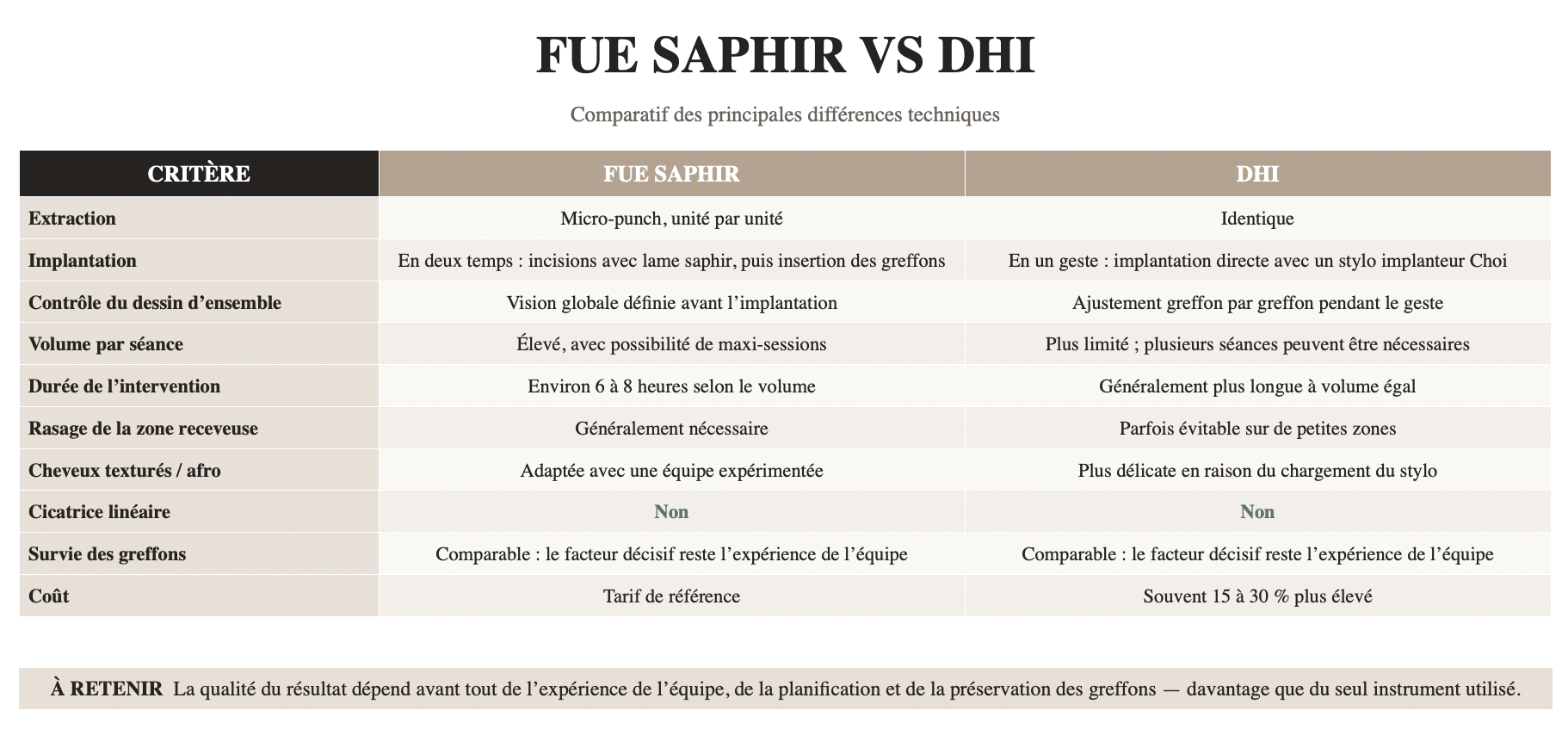
A key point, too often overlooked: DHI is not an alternative to FUE; it is a variation of FUE. In both techniques, the first step is identical: follicular units (1 to 4 hairs each) are extracted one by one from the donor area —the back and sides of the scalp, where hair is genetically resistant to hair loss—using a micro-punch less than a millimeter in diameter, under local anesthesia.
Neither technique leaves a linear scar, unlike the older FUT strip method. The difference lies entirely in the second phase of the procedure: graft implantation.
- Sapphire FUE : The practitioner first creates all the recipient sites using a synthetic sapphire blade, then the grafts are inserted into these micro-incisions. Two distinct steps.
- DHI (Direct Hair Implantation) : Incision and implantation are performed in a single motion using an implanter pen (Choi implanter), in which each graft is loaded and then injected directly into the scalp.
2. Sapphire FUE: Precision through the blade, a comprehensive view
The sapphire blade is cut from a synthetic crystal that is much harder than surgical steel. Its V-shaped tip, which is extremely fine and stays sharp, allows for clean 1 to 1.5 mm incisions that are minimally traumatic to surrounding tissue.
But the structural advantage of the method lies in its two-step logic: by creating all recipient sites before implantation, the practitioner maps out the entire result—angles, directions, and density distribution—with a comprehensive view of the area. Whether on a hairline, where each hair must follow a precise acute angle, or on a crown where the implantation follows a spiral pattern, this overall control is a decisive asset for a natural-looking result. This approach is detailed on the Hexagone Clinic hair transplant page.
Other features: healing of sapphire micro-incisions is generally rapid (scabs fall off around the 7th to 10th day), and the technique is well-suited for high-volume sessions, including maxi-sessions, as the incision phase can be optimized without the constraints of loading an implanter pen.
3. DHI: Direct implantation with the Choi pen
With DHI, each graft is placed into the hollow needle of an implanter pen and then implanted in a single motion that simultaneously creates the incision and deposits the follicle. The arguments put forward by its proponents:
- Reduced time outside the body : the graft spends less time between extraction and implantation, which is said to limit dehydration;
- No pre-made recipient sites : incisions are not made in advance, which may slightly reduce bleeding;
- Implantation possible without full shaving of the recipient area in certain cases, a common argument for women or localized corrections;
- Fine density on small areas : the individual motion is well-suited for targeted touch-ups (temples, limited hairline).
The less frequently mentioned limitations
DHI also presents real constraints that are rarely highlighted in brochures:
- Extreme dependence on the operator : the angle and depth are determined graft by graft, at the moment of the procedure. Without a prior overall vision, the homogeneity of the result relies entirely on the consistency of the hand holding the pen—often several hands taking turns during the same session;
- Limited volume per session : loading the pen graft by graft extends the procedure time; large areas often require multiple sessions, whereas a Sapphire FUE can treat the area in one go;
- Mechanical pressure on the graft : the follicle is compressed within the pen needle, an additional stress that the two-step technique avoids;
- Generally higher cost, as the operating time and equipment requirements are greater;
- Less suitable for very curly hair under the skin (textured/Afro hair), which is difficult to load into the implanter without damage.
4. What comparative studies say
An important point to look past marketing claims: published studies comparing DHI and FUE with pre-made incisions show no systematic superiority of one method over the other in terms of graft survival rates or aesthetic results at one year. The differences observed between clinics are primarily explained by the experience of the teams, the volume of patients treated per day, and the quality of the planning—not by the choice of implantation instrument.
In other words: a carefully performed DHI will yield a better result than a botched Sapphire FUE, and vice versa. The technique is a tool; the result is a skill. This is why examining real before/after results from the clinic remains the most reliable comparison criterion.
5. Which technique for which profile?
a. Cases where Sapphire FUE is the most solid choice
- Extensive areas and advanced baldness : the ability to treat a large volume in a single session, including in "maxi-sessions" with the use of BHT (beard/body hair harvesting) if the scalp donor area is limited, makes it the gold standard for large-scale coverage;
- Complete hairline reconstruction : comprehensive incision planning ensures consistent angles across the entire line;
- Textured hair, such as in Afro hair transplants, where curved follicles are easier to handle outside of an implanter pen;
- Seeking the best value for money, as DHI is structurally more expensive for the same volume.
b. Cases where DHI may be considered
- Highly localized touch-ups on a small area for patients who refuse to shave;
- Limited female hair density improvement without shaving the recipient area.
However, these cases require a team truly experienced with the implanter pen, as DHI is unforgiving of inexperience.
6. The Hexagone Clinic choice: why Sapphire FUE
For the sake of transparency: Hexagone Clinic performs Sapphire FUE, not DHI. This choice is not due to a lack of equipment, but a deliberate medical stance based on three reasons:
- two-stage planning provides overall control of the hairline design, which we consider crucial for a natural-looking result;
- it allows for the treatment of extensive hair loss in a single session, including mega-sessions, which accounts for the majority of requests we receive;
- with comparable results according to studies, it avoids charging the patient for the extra time required by the implanter pen.
Our Sapphire FUE procedures range between €2,800 to €7,800 depending on the number of grafts; details by volume can be found on the pricing page. If, during your initial consultation, your situation suggests that DHI would be objectively more appropriate, our team will tell you, even if it means referring you elsewhere. Any clinic that presents its own technique as universally superior should be approached with caution, regardless of the method.
7. Beware of marketing claims, especially abroad
DHI is heavily promoted by medical tourism clinics, often using unverifiable claims ("patented technique," "100% graft survival rate") and attractive package deals. Useful reminders before you compare:
- a very low price per graft is often accompanied by a very high volume of patients per day, which is incompatible with the level of care that DHI specifically requires;
- the post-operative medical follow-up — including check-ups at 10 days, 3, 6, and 12 months — is difficult to ensure from 3,000 km away; in the event of complications or disappointing results, any corrective work will be at your own expense;
- no technique, whether DHI or Sapphire, can guarantee a specific result: be wary of any numerical promises.
For patients in the Nice area and the French Riviera, having an in-person consultation with the same team before and after the procedure remains the safest option; details are available on the hair transplant in Nice page.
8. Key takeaways
- Sapphire FUE and DHI share the same extraction method; they differ in implantation: two steps with a sapphire blade versus a single motion with an implanter pen.
- Studies do not show a systematic superiority of one technique over the other: the team's experience is the true deciding factor.
- Sapphire FUE excels for large areas, mega-sessions, full hairlines, and textured hair; DHI is worth considering for small touch-ups without shaving.
- DHI is generally 15 to 30% more expensive for the same volume, with comparable results.
- Hexagone Clinic (Nice) performs Sapphire FUE, ranging from €2,800 to €7,800 depending on the number of grafts.
Frequently Asked Questions
Is DHI more natural-looking than Sapphire FUE?
No, not inherently. Natural results depend on the angle, direction, and distribution of the grafts—in other words, the skill of the team. Sapphire FUE actually offers a planning advantage for larger areas.
Is graft survival better with DHI?
Published comparative studies show no significant difference in graft survival between DHI and FUE with pre-made incisions when both are performed correctly. While the argument regarding "reduced time outside the body" is valid, its clinical impact has not been proven to be decisive.
Why is DHI more expensive?
The individual implantation process using an implanter pen increases operating time and requires more equipment and staff. For the same number of grafts, this is reflected in the price, which is generally 15 to 30% higher than Sapphire FUE.
Can I have a hair transplant without shaving my head?
This is a common selling point for DHI, primarily applicable to small areas. Alternatives exist with FUE, such as the long-hair transplant performed at Hexagone Clinic, which allows you to see the results immediately; see the long-hair transplant page.
Is the recovery different between DHI and Sapphire FUE?
The recovery process is very similar: scabs on the recipient area for 7 to 10 days, temporary redness, and a return to work possible within a few days depending on your activity. The regrowth timeline is identical: it begins around 3–4 months, with final results visible between 12 and 18 months.
Can Hexagone Clinic tell me which technique is right for me?
Yes. During an initial, no-obligation consultation, the team will assess your donor area, the size of the area to be covered, and your goals. They will then explain what is achievable with Sapphire FUE, including the number of grafts and the cost, and will be honest if your case requires a different approach.
Discuss your case with the Hexagone Clinic team
Rather than trying to choose between two acronyms on your own, share your situation with a medical team that will provide you with facts: feasibility, number of grafts, the appropriate technique, and precise pricing.
✓ Response within 24 hours · ✓ 100% confidential · ✓ No obligation
You can also book an appointment directly online.