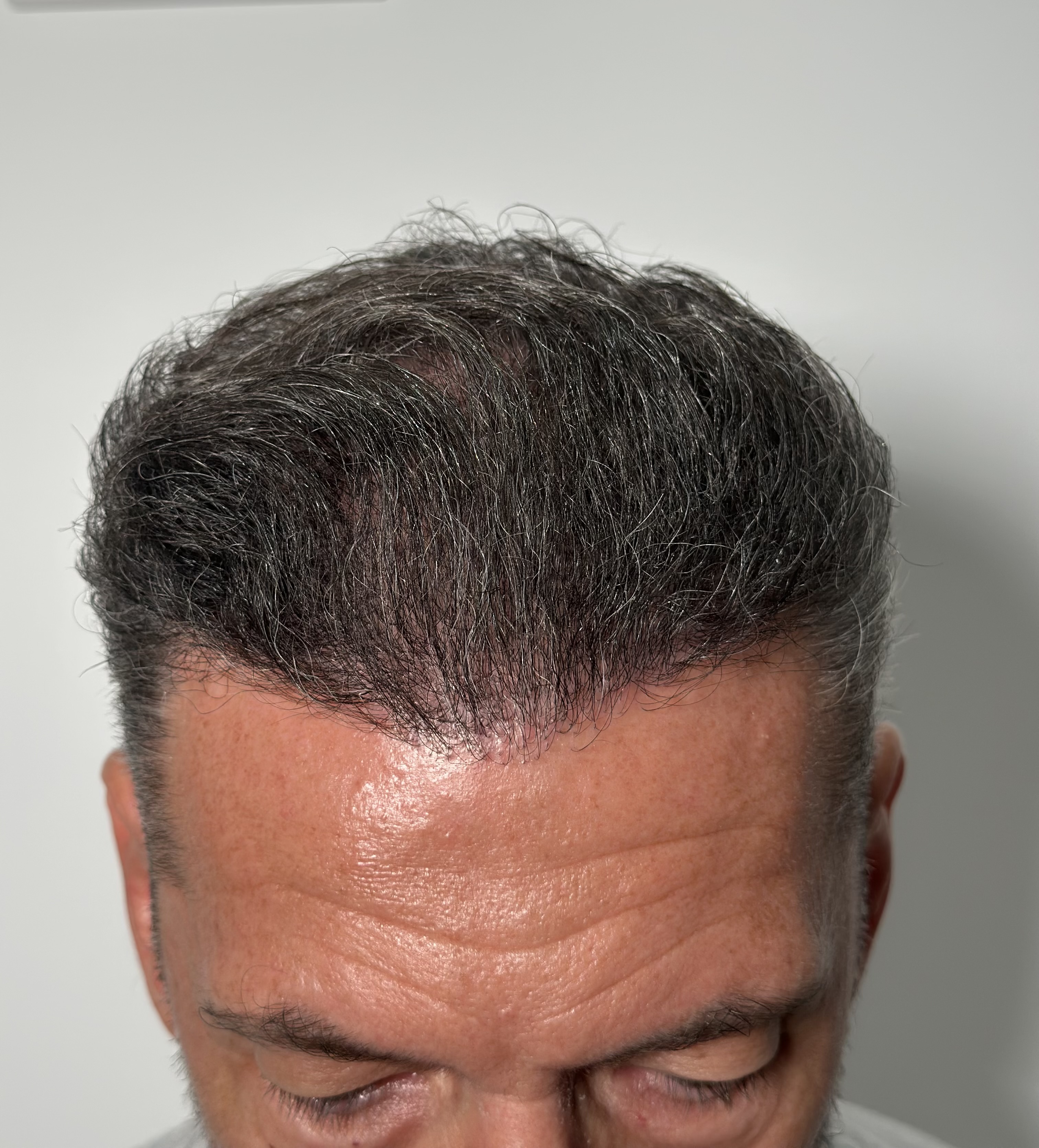





For the past two or three years, one word has been cropping up in conversations about hair loss: exosomes. Sometimes touted as the next hair-care revolution, they spark as much hope as they do confusion. What exactly are exosomes? What does current research show? And most importantly, where is the line between a promising scientific lead and a marketing gimmick? At Hexagone Clinic in Nice, we believe in balanced information: here is the 2026 status report, with no empty promises or shortcuts.
1. What is an exosome?
An exosome is a tiny vesicle a sort of biological "package" released by cells to communicate with one another. It carries proteins, growth factors, and genetic fragments (messenger RNA, micro-RNA) that influence the behavior of recipient cells. In regenerative medicine, the exosomes used most often come from stem cells cultured in a laboratory.
When applied to the scalp, the idea is to deliver a biochemical signal to the hair follicles that can jump-start their activity. Unlike minoxidil or finasteride, which act through a single mechanism, exosomes deliver a complex mixture of active molecules.
2. Why exosomes are of interest to hair research
Published studies describe several potential mechanisms: stimulation of dermal papilla cells (the follicle's "engine"), improvement of scalp micro-vascularization (angiogenesis), and modulation of local inflammation. These three levers correspond to known factors in the progression of androgenetic alopecia.
On paper, the approach is compelling. But a plausible mechanism in a lab is not enough: what matters is clinical demonstration in humans over time exactly the kind of standard that distinguishes a proven hair loss solution from a passing trend.
3. What studies say in 2026
A recent systematic review identified about a dozen clinical studies on exosomes for hair regrowth, including two randomized controlled trials the gold standard complemented by retrospective studies, case series, and isolated reports. Initial results indicate improvements in density for some patients.
Three important caveats accompany these data:
- Small sample sizes : most studies involve a small number of participants, which limits the scope of the conclusions.
- Inconsistent protocols : exosome sources, concentrations, number of sessions, and measurement methods vary from one study to another, making comparisons difficult.
- Ongoing trials : several studies evaluating exosome formulations for hair thinning are still in the data collection phase, with results expected throughout 2026.
In other words, while this is a genuine avenue being closely monitored by the scientific community, the current level of evidence is insufficient to classify it as an established treatment.
4. Exosomes vs. PRF: What’s the difference?
It is a common point of confusion. PRF (platelet-rich fibrin) uses your own blood, which is centrifuged to concentrate your platelets and growth factors. It has a much longer clinical track record and a clear regulatory framework.
Exosomes, on the other hand, are generally derived from external cells cultured in a laboratory, and both their standardization and regulation are still evolving. In practice, PRP is currently a well-documented and regulated option, whereas exosomes remain in a more experimental phase.
5. The regulatory landscape in France: Proceed with caution
In France, cell-derived products are strictly regulated. At this stage, no exosome-based hair treatment has been authorized as a validated, regulated solution for hair loss. Any marketing that presents exosomes as a "miracle cure" or a "guaranteed regrowth" solution should therefore be viewed with significant skepticism.
Our position at Hexagone Clinic is simple: we follow research developments with interest, but we refuse to sell promises that science does not yet support. Our patient results are based on proven techniques, not hype.
6. Exosomes and hair transplants: Two different approaches
It is essential to distinguish between two situations. When a follicle is still alive but weakened, various approaches can be used to stimulate it. However, when the follicle has permanently disappeared, no serum or injection can bring it back to life : only a hair transplant can move living follicles to the thinning area.
If their benefits are confirmed, exosomes would therefore be a potential supplement , never a substitute for a transplant once baldness has set in. This is also why acting early, at the first signs of hair loss, remains the best way to preserve your options.
Frequently asked questions
Do exosomes make hair grow back?
Early studies suggest a potential effect on density for some patients, but the level of evidence remains limited as of 2026. Results cannot be guaranteed.
Do exosomes replace a hair transplant?
No. No treatment can recreate a lost follicle. For established baldness, a transplant remains the only solution to restore density.
Is it available in France?
The field is still experimental and strictly regulated. It is best to be wary of offers presenting exosomes as a validated solution.
Want to get a clear picture of your situation?
Every scalp is different, and the right solutions depend on many factors. Rather than following a trend, let's discuss your needs during an initial, no-obligation consultation. Our team will get back to you within 24 business hours.
→ Request a callback · ✓ Response within 24h · ✓ 100% confidential · ✓ No obligation